THE Impact Ranking 2025
12 November 2023
2 menit
Dilihat 0x
Climate Action
Trash in rivers can have a detrimental impact on the surrounding environment, such as increasing the risk of flooding and spreading diseases. Currently, the government cleans rivers using conventional...
SPenulis: SDGS Telkom UniversitySEditor: SDGS Telkom University
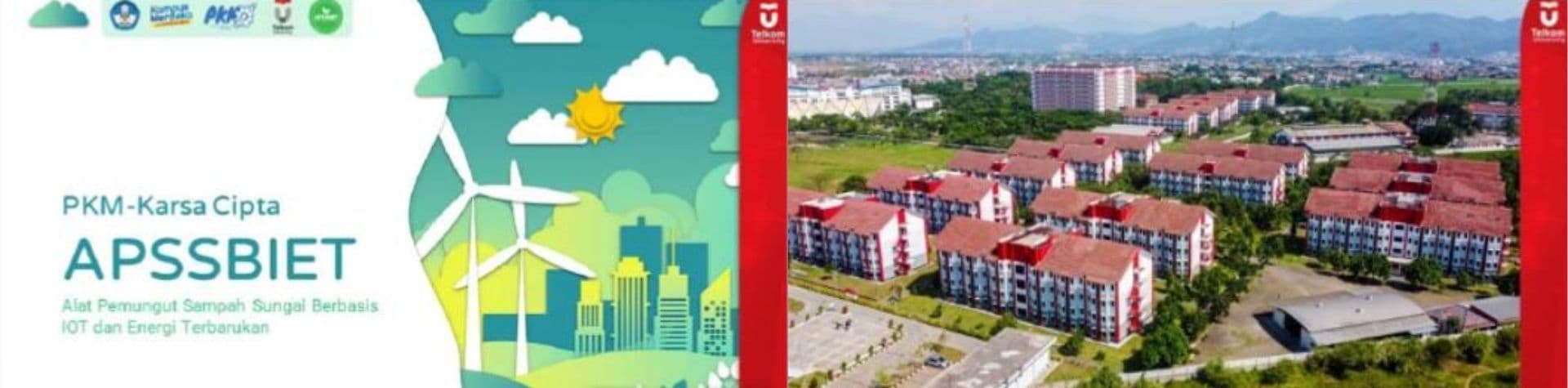
Trash in rivers can have a detrimental impact on the surrounding environment, such as increasing the risk of flooding and spreading diseases. Currently, the government cleans rivers using conventional methods with heavy equipment, and it is not done regularly. To conduct river cleaning that is efficient, flexible, and environmentally friendly, a student creativity program group from Telkom University (Tel-U) called APSSBIET (River Trash Collector Based on IoT and Renewable Energy) has developed a river cleaning tool powered by renewable energy, specifically solar panels that are environmentally friendly.
The APSSBIET group consists of five students from the S1 Information Technology program in the Faculty of Informatics: Yani Sofyan, Muhamad Raihan, Hubert Igor, Naufal Ahmad, and Reihan Akmal, under the guidance of Dr. Gamma Kosala.
Yani explained that APSSBIET aims to create a river cleaning tool based on IoT (Internet of Things) and renewable energy. Through the use of this environmentally friendly cleaning tool, it does not cause pollution or damage nature. The use of IoT in the tool allows for monitoring and remote control.
Telkom University, through the Faculty of Electrical Engineering (FTE) and the S1 Physics Engineering Program, has created a micro-sensor-based pollutant detection tool that can control air pollution amidst the limitations of measuring instruments. This tool can measure particulates smaller than 2.5 micrometers (PM2.5, fine particles), and gases such as CO and CO2 (carbon emissions), SO2 and HCl (corrosion), O3 and CH4 (greenhouse gases), and NOx (transportation). The tool has been calibrated on a laboratory scale, colocated with reference instruments, and validated for long-term measurements. With the presence of this tool, it is expected that the gap in air quality information can be reduced, encouraging the public to care and actively contribute to environmental protection. Additionally, validated data can serve as an early warning system and as a basis for further decision-making.
From a publication perspective, in 2023, we have released a total of 17 research publications in accredited journals andconferences related to SDG 13.
The full list of the publication can be accessed here: https://docs.google.com/spreadsheets/d/1t1XspE__395JwbtveTSHd3wplxbe_jN_/edit?gid=1936014308#gid=1936014308
Full Sustainability Report On SDGs 13 can be accessed here: https://drive.google.com/file/d/1kfy1ynUmZpevjZYBOeHXkz3iZ_pQA40u/view
#THE Impact Ranking 2025
Bagikan Artikel
0Komentar