THE Impact Ranking 2025
24 Desember 2023
2 menit
Dilihat 0x
Life On Land
Telkom University, in collaboration with the Astacala Foundation, has undertaken a significant initiative to protect the upstream flow of the Citarum River through the empowerment of coffee production...
SPenulis: SDGS Telkom UniversitySEditor: SDGS Telkom University
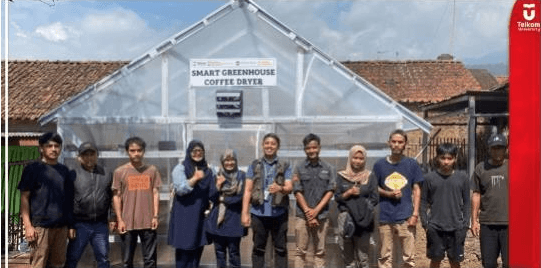
Telkom University, in collaboration with the Astacala Foundation, has undertaken a significant initiative to protect the upstream flow of the Citarum River through the empowerment of coffee production. This effort is part of a community service project organized by the Directorate of Research and Community Service, involving the Control, Electronics, and Intelligent Systems Research Group from the Faculty of Electrical Engineering. The flagship community service project, titled "Designing a Greenhouse as an Appropriate Solution for Coffee Bean Drying for the Cinanggela Village Community," is located 26 kilometers from Telkom University. Cinanggela Village is vulnerable to land shifts due to poorly managed vegetable farming in hilly areas, leading to soil erosion. Vegetable plants, which require open sunlight and cannot hold the soil during rain, pose a significant risk of land erosion and water pollution due to sedimentation from chemical materials. Moreover, the plantations in Cinanggela Village, located in the Malabar Mountains and near the upstream flow of the Citarum River, are at risk. Coffee cultivation not only contributes to the preservation of the Citarum River's integrity and erosion reduction but also plays a vital role in overall environmental conservation. This conservation activity focuses on coffee production as an entry point to preserve the area and provide economic support to the local community. By improving the quality of coffee produced in Cinanggela Village, the economy can shift from vegetable farming as the primary livelihood. Continuous efforts to enhance coffee quality, which is already recognized as one of the best nationally, can be achieved through the initial stage of coffee bean processing, which involves drying using a greenhouse that adopts scientific knowledge and technological advancements. The drying time can be accelerated from about 25 days to only 18 days compared to conventional methods. With assured quality coffee processing and digitalization, it is hoped that coffee from Cinanggela Village will be able to compete internationally, thereby boosting the local economy, preserving the environment, and advancing education in the village. The construction of the greenhouse is a first step in a sustainable journey. The coffee bean drying process has been automated based on
temperature control between 25 and 45 degrees Celsius using real-time temperature and humidity sensors.
If the temperature is too low, artificial heating will be activated, while if it is too hot, a cooling circulation system will operate. Additionally, the potential development of this greenhouse involves utilizing renewable energy sources, such as solar power (PLTS) or biomass, within the greenhouse system. This further emphasizes the commitment to sustainability and environmentally friendly practices.
From a publication standpoint, in 2023, we have released a total of 7 research publications in accredited journals andconferences related to SDG 15.
#THE Impact Ranking 2025
Bagikan Artikel
0Komentar