THE Sustainability Impact Ratings 2026
12 April 2024
2 menit
Dilihat 0x
Telkom University Advances Sustainable Water Extraction and Monitoring Technologies
Keywords:WaterSustainability, SmartMonitoring, Innovation Sustainable Water Extraction on Campus Telkom University implements a comprehensive water conservation and filtration system across its campu...
SPenulis: SDGS Telkom UniversitySEditor: SDGS Telkom University
Keywords:WaterSustainability, SmartMonitoring, Innovation
Sustainable Water Extraction on Campus
Telkom University implements a comprehensive water conservation and filtration system across its campus. Each building is equipped with infiltration wells, allowing rainwater to seep naturally into the ground instead of flowing directly into reservoirs. This infiltration process enhances groundwater recharge while preventing surface flooding and soil erosion. Wastewater from buildings is directed to a dedicated filtration reservoir for treatment prior to discharge into Lake Tekno, the university’s main water body. This reservoir acts as a pollution prevention mechanism, filtering and purifying wastewater to remove contaminants and sediments. The water flow sequence on campus follows a structured pathway:
building infiltration → filtration reservoir → Lake Tekno.
From there, treated water is further processed and, when necessary, safely released into surrounding rivers through the Wastewater Treatment Plant (IPAL) and a series of retention ponds and infiltration lakes. These systems ensure that all discharged water meets environmental safety standards, demonstrating the university’s commitment to responsible water management and ecosystem protection. Together, these mechanisms exemplify Telkom University’s sustainable extraction model, balancing efficient water use, recycling, and ecological preservation.
IoT-Based Water Quality Monitoring
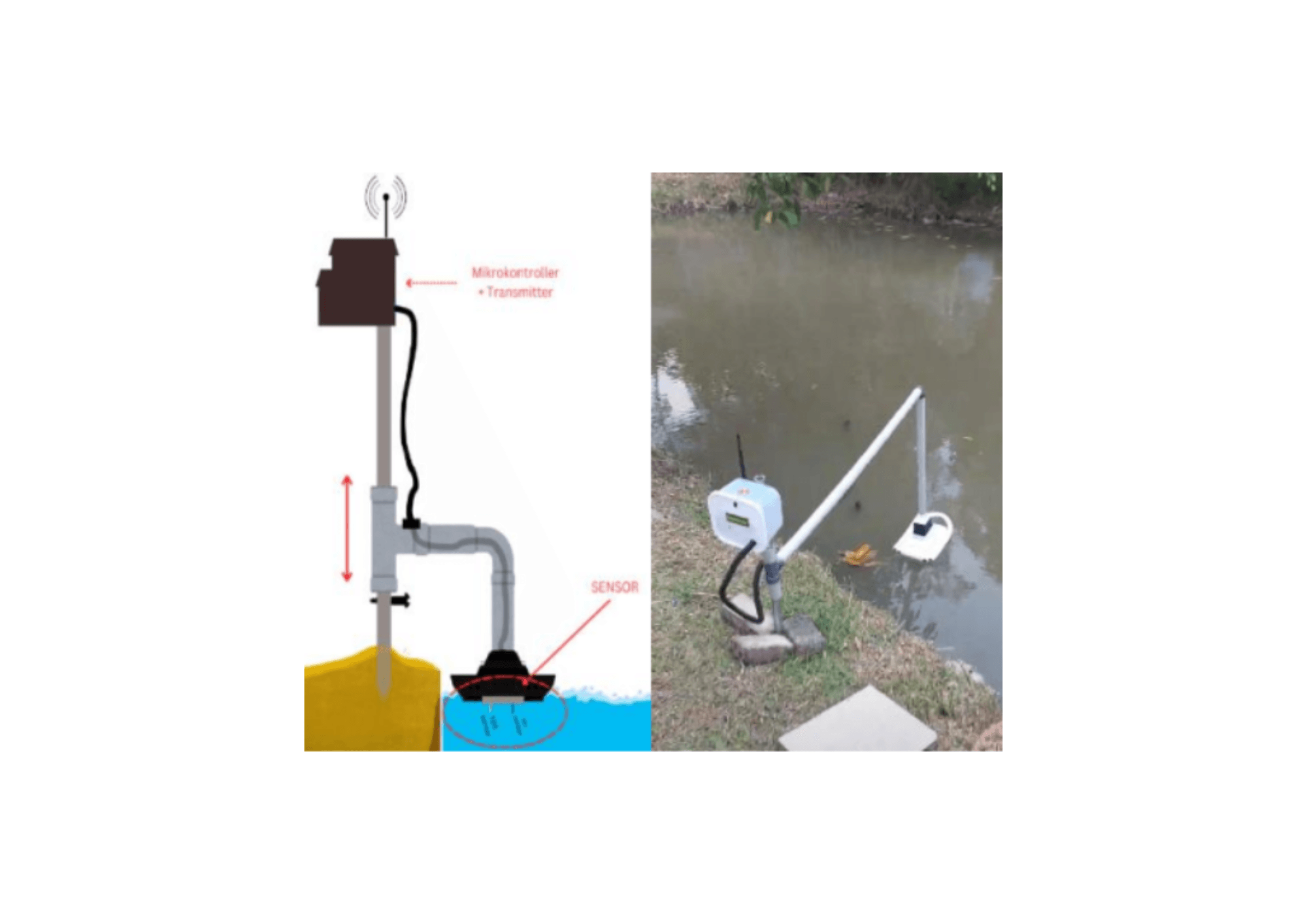
Complementing its on-campus systems, researchers from the Faculty of Electrical Engineering have developed a LoRa-based River Water Quality Monitoring System. This IoT innovation provides real-time monitoring of the Citarum River, measuring critical parameters such as pH and Total Dissolved Solids (TDS) using wireless sensors. The device transmits data to a central database for continuous analysis, achieving 94.4% accuracy for pH and 85.9% for TDS, with a maximum transmission range of nearly 68 meters. This system offers a safer, faster, and more efficient alternative to manual sampling—supporting large-scale environmental monitoring and pollution prevention efforts under programs like Citarum Harum, aimed at restoring West Java’s river ecosystems.
Community Service and Sustainable Education
Through lecturer and student community service programs (Pengabdian kepada Masyarakat), Telkom University extends its environmental research and technology applications to local communities. Activities include training on water treatment, rainwater harvesting, and renewable-energy-based clean water systems, empowering residents to implement sustainable water practices in daily life.
Conclusion
By integrating sustainable water extraction systems, pollution prevention mechanisms, IoT-based monitoring, and community-driven education, Telkom University demonstrates a holistic approach to water sustainability.
Through these interconnected efforts, the university ensures that every drop of water is managed responsibly and safely, reaffirming its leadership in environmental innovation, education, and sustainable campus development—for the benefit of both people and the planet.
source image: Journal Telkom University Website
#THE Sustainability Impact Ratings 2026
Bagikan Artikel
0Komentar