THE Impact Ranking 2025
1 Juli 2023
3 menit
Dilihat 0x
Telkom University: Pioneering Sustainable Energy Solutions Through Research and Innovation
As a campus that prioritizes technology, of course, this makes Telkom University require quite a lot of energy in its activities. In the context of the energy saving movement within Telkom University,...
SPenulis: SDGS Telkom UniversitySEditor: SDGS Telkom University
As a campus that prioritizes technology, of course, this makes Telkom University require quite a lot of energy in its activities. In the context of the energy saving movement within Telkom University, in addition to saving electricity, water and others, Telkom University carries out energy monitoring through the results of research products that have been implemented within Telkom University.
Several research products used to identify electrical energy consumption as a step to reduce unnecessary energy at Telkom University include:
1. Prediction Of Electric Energy Consumption In The Household Sector In Indonesia Using Grammatical Evolution
2. Smart Lighting System For Building A Green Ecosystem Based On The Internet Of Things (Iot) Case Study: Pt Bio Farma (Second Year)
3. Intelligent Energy Management System (Iems) (Second Year)
4. Prediction Of Energy Consumption Towards One Hundred Years Of Independent Indonesia Using Grammatical Evolution
5. Creation Of A Microhydro Power Plant Simulator To Increase Human Competency In Supporting The National Energy Mix Program More on the Agreement of the project:View Here
The results of energy reduction based on the implementation of energy monitoring results include:
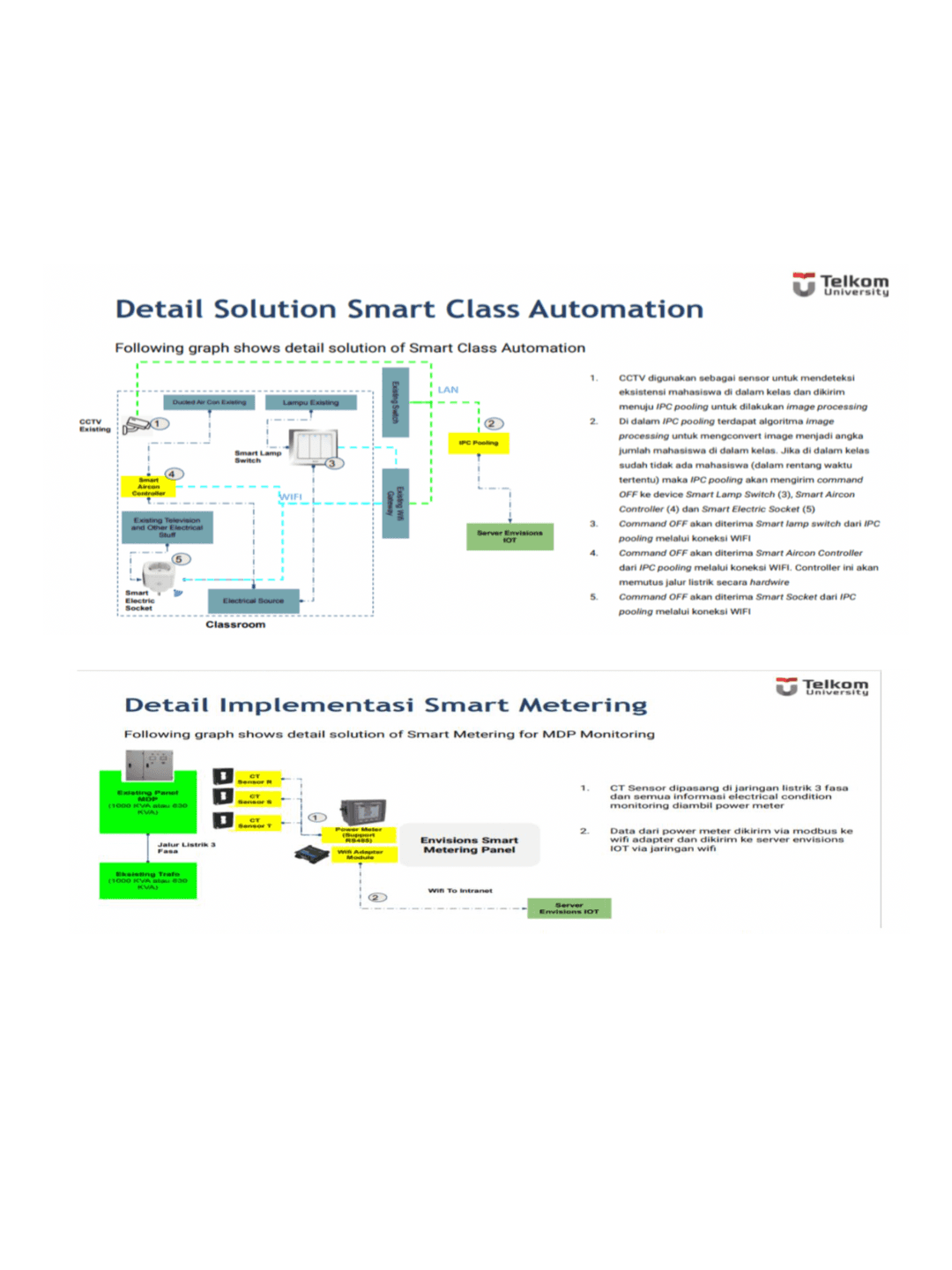
1. Smart Class Automation: This is an automation system for using electronic devices with CCTV technology. In this system, CCTV acts as a sensor to detect the presence of students in the classroom through image processing. If the CCTV detects that there are no students (people) in the room for a certain period, it sends an "Off" command to the smart lamp switch, Smart Air Conditioner controller, and smart electric socket.
2. Smart Meter Implementation: Smart Meter Monitoring is essential for monitoring electrical conditions and energy usage. It utilizes smart measurements for three-phase electrical conditions and energy consumption on the MDP panel (a secondary panel from the
transformer). The system provides real-time web-based monitoring of three-phase electrical conditions and energy usage and displays energy usage reports via a web interface. An alarm is triggered if any parameter exceeds certain thresholds.
3. Use of LED lights for street lighting using LEDs. Of the total 225 public street lighting in Telkom University, 221 have used LED lights (98.2%). The rest are only 4 lights that have not used LEDs
4. Meeting room and a TA courtroom that uses LED screens. The use of this LED screen will save electricity consumption compared to the Projector. As many as 40% of the meeting rooms and courtroom TA have used LED screens. In addition, some laboratories use the All-in-One PC with electricity consumption of the All in One PC is 12.5% lower than conventional PCs (All in one 65 Watts, conventional PCs 550 Watts)
5. Telkom University employees using laptops in their daily work. As many as 74% of all Telkom University employees (lecturers and staff) use laptops. Electricity consumption from laptops is only 8% compared to conventional PCs.
6. We have also implemented a program to replace room lighting using LED lighting. This year around 1250 lamp units have been replaced with LEDs. The electricity consumption of LED lamps is only 10% of conventional lamps. In the future Telkom University has planned to replace room lamps that are not yet LED. In 2019, Telkom University budgeted Rp. 250,000,000 (two hundred and fifty million rupiah) for the replacement of this LED lamp.
7. Telkom University is planning to use a temperature sensor that will be installed in every room that uses AC as much as 30% lower with the following temperature settings:
a. Laboratory: 22 – 25 degrees Celsius
b. Server Room: 18 – 20 degrees Celsius (1 room)
c. Workspace: 24-27 degrees Celsius
Telkom University is also developed an energy use dashboard in several buildings, namely the Electrical Monitoring System (EMS). EMS is an application that displays power panel information from Telkom University. In addition, this application also displays a graph of the system power. So, this is a panel system monitoring application to display electricity consumption at Telkom University. With this monitoring from EMS, it will be seen the amount of energy use in the Telkom University area, because each building is different. Later, these results can be carried out efficiently so that there is no excessive waste.
#THE Impact Ranking 2025
Bagikan Artikel
0Komentar